
ISO 9001:2015 Certified · Manufacturer & Exporter
Industry · Chemical, Bromine & Salt

Water Treatment Chemicals for the Chemical, Bromine & Salt Industry

Chemical plants depend on steam, cooling and treated water around the clock — often from hard borewell or brine-influenced water along the Gujarat coast. We supply and support treatment programmes for boilers, reactor and condenser cooling towers, and RO plants in chemical, bromine and salt manufacturing units.

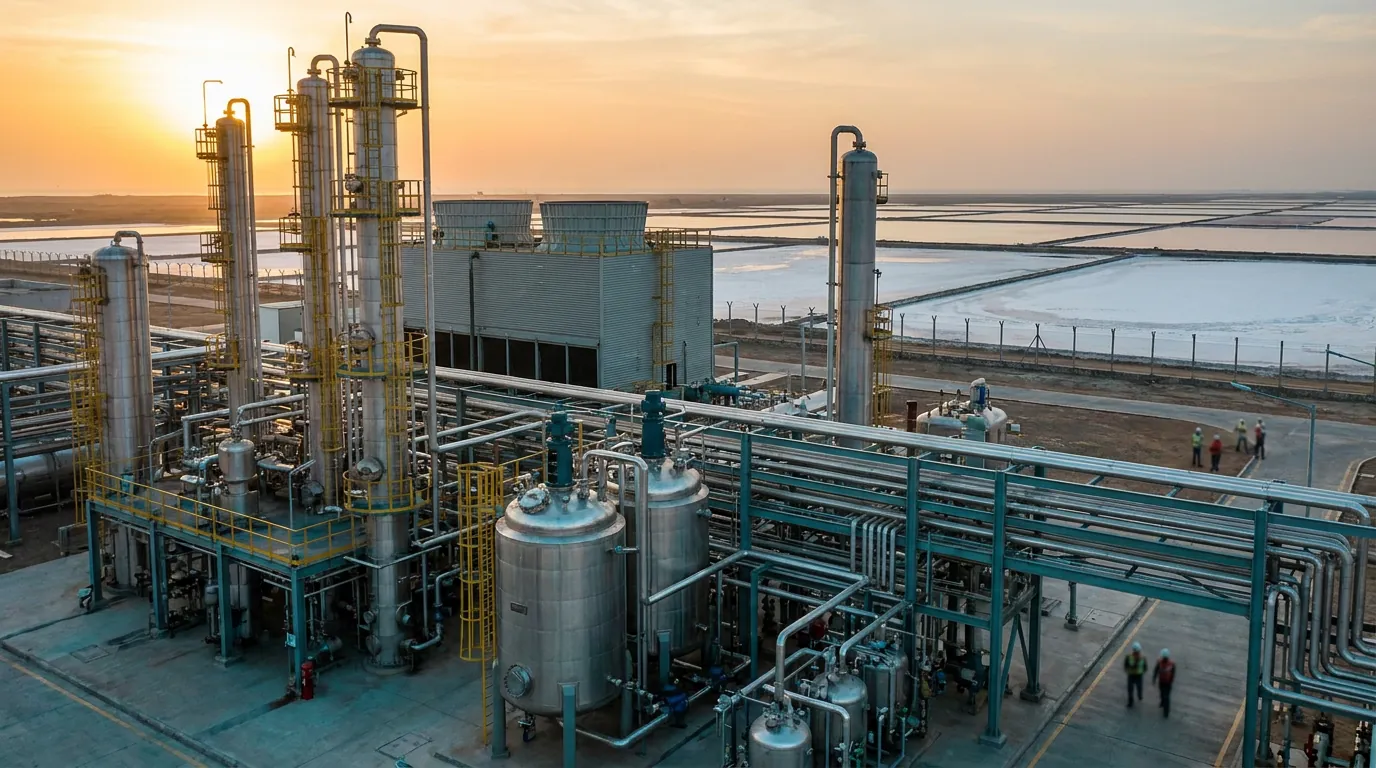
Chemical process plant with distillation columns and a cooling tower beside coastal salt pans
Plant map

Where Water Works in a Chemical, Bromine & Salt Plant

  1. Reactor jackets & condensersHeat removal that sets batch time and yieldCooling
  2. Process steam & jacket heatingDistillation, evaporation and dryingBoiler
  3. Process & boiler-feed waterRO on hard borewell or saline waterRO
  4. Brine & bittern handlingBromine, salt and derivative streamsSeawater
  5. Vacuum & utility coolingEjector condensers, compressors, pumpsCooling
Systems we treat

Water Systems in Chemical, Bromine & Salt Plants

Tap a product to see it, or open the full programme for that system.

Running on seawater or brine? We also treat brine streams and seawater-cooled systems — see our high-salinity programme.Seawater Treatment
What we measure

Water Parameters We Watch

The readings that matter most in chemical, bromine and salt plants — tracked from your first analysis through monthly reviews.

  • ChlorideBrine-influenced make-up water drives pitting in exchangers — it sets how far cycles can be pushed.
  • Hardness & alkalinityDecide scale risk in condensers and boilers and the antiscalant dose needed.
  • pH drift & organic loadA sudden change in cooling water often signals a leaking process exchanger.
  • Microbial countOrganic leaks feed bacteria — counts tell us when to shock dose.
  • Conductivity / TDSControls blowdown so the system runs at its safe cycles of concentration.
Common problems

What We Solve

  • High-chloride corrosionBrine-influenced water attacks heat exchangers and pipework; dosing is set against your chloride levels.
  • Hard-water scaleHardness from borewell water deposits on condensers and boiler tubes.
  • Bio-fouling from process leaksOrganic leaks feed bacteria and slime in cooling towers — controlled with alternating biocides and bio-dispersant.
  • Process foaming issuesOur team also supports process-side problems such as column foaming, with options trialled at your plant.

Why Chemical Plants Work with Kranti Water

  • Experience with high-TDS, high-chloride Gujarat water
  • MSDS, COA and technical data sheet (TDS) shared for your process-safety review
  • On-site dosing support from our Vadodara team
Questions

Chemical, Bromine & Salt FAQ

How do process leaks affect cooling tower treatment?

Organic or acidic leaks into cooling water feed bacteria, consume inhibitor and shift pH. We watch for early signs — pH drift, rising counts, falling residuals — and adjust dosing, but locating and repairing the leaking exchanger is the lasting fix.

Can you treat cooling water with high-chloride or brine-influenced make-up?

Yes — high-salinity water is one of our specialist areas. Programmes are set from a full analysis of your make-up and system water; see our seawater and high-salinity treatment page for details.

Do you provide documents for our process-safety review?

Yes. Every product comes with a technical data sheet (TDS) and MSDS, and COA is available per batch on request, so your safety and quality teams can review before trials.

Get a Programme for Your Plant

Send a water sample or your latest analysis report. We'll recommend products and dosages for each system within 48 hours.

Send Your Water Analysis