Extreme Salinity
Around 35,000 mg/L of dissolved salts — high in calcium, magnesium and sulphate — so scale forms fast as water heats or concentrates.

Seawater is the hardest water any plant has to treat: extreme salinity, aggressive chloride and constant marine fouling. Alongside our programmes for fresh and borewell water, we design and support treatment for seawater cooling towers, once-through seawater cooling, SWRO desalination and brine streams — for plants along India's bromine and salt coast.
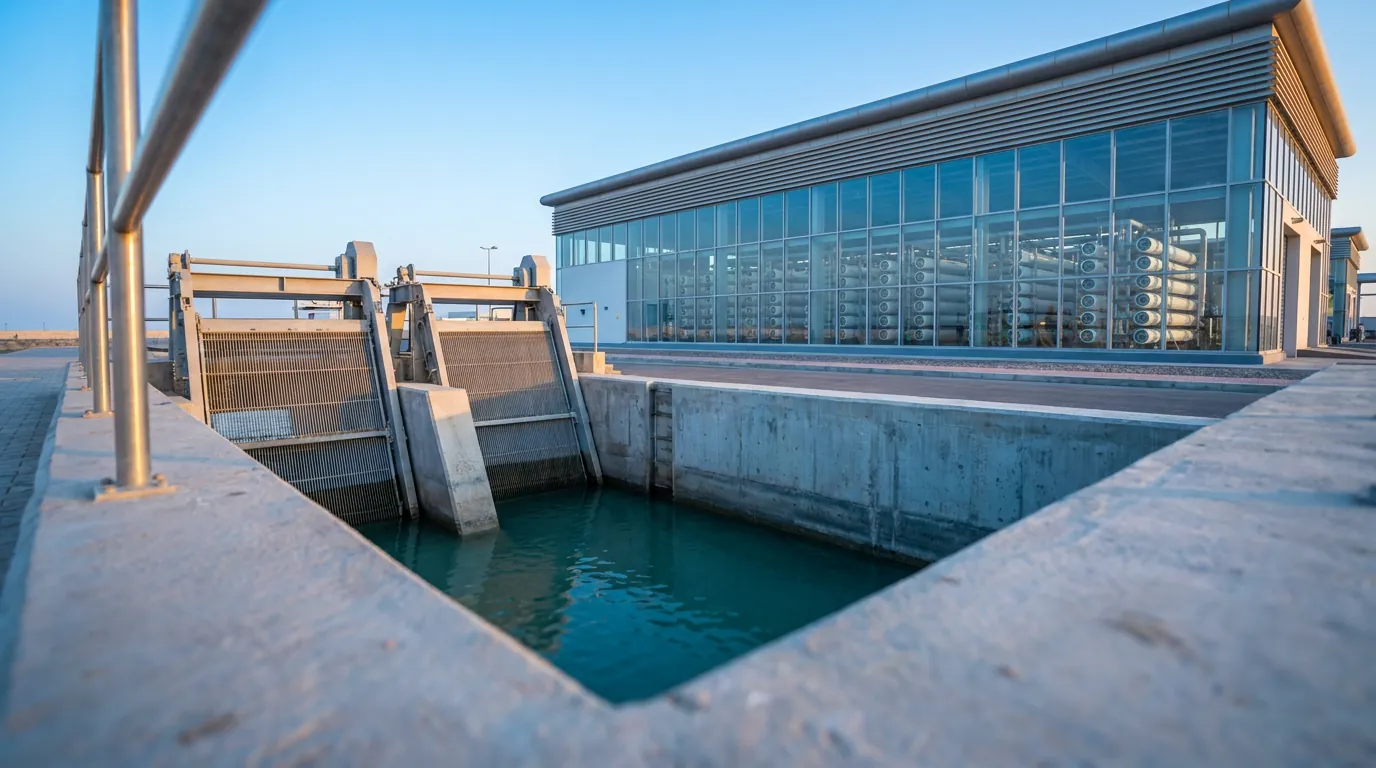
Seawater carries around 35,000 mg/L of dissolved salts, compared with a few hundred mg/L in typical river or municipal water. Every problem a freshwater system has, seawater has faster and harder.
Around 35,000 mg/L of dissolved salts — high in calcium, magnesium and sulphate — so scale forms fast as water heats or concentrates.
Roughly 19,000 mg/L of chloride attacks carbon steel, pits stainless steel and stresses copper-alloy condenser tubes.
Slime, barnacles and mussels colonise intakes, screens and heat exchangers within weeks if left untreated.
Seawater towers run at low cycles and SWRO at 55–70 bar — small dosing mistakes quickly become big losses.
Products shown are what we typically select from our range. Grades and dosages are confirmed after your seawater analysis.
Tower antiscalant Bacteria & algae biocide Broad-spectrum biocide Bio-dispersant
Bacteria & algae biocide Broad-spectrum biocide Bio-dispersant
High-TDS antiscalant Ca/Mg/metal antiscalant Acid cleaner Organic cleaner Membrane biocide
Yes. We design seawater cooling tower programmes covering scale control, metal protection, an alternating biocide schedule and bio-dispersant, set after a full analysis of your seawater and system.
Much lower than with fresh water — seawater towers typically run below 2 cycles because calcium sulphate and carbonate scaling limits are reached quickly. We set the target from your own seawater analysis.
Yes — RO antiscalants, acidic and alkaline CIP cleaners and membrane-compatible biocide. The antiscalant grade is chosen from your feed analysis and recovery.
With a planned biocide programme — alternating chemistries so organisms do not adapt — plus bio-dispersant to break biofilm, and monitoring of heat exchanger performance to catch fouling early.
Most plants we support run on fresh, borewell or municipal water. The same team, analysis and programmes cover every water source.
Share your seawater or brine analysis — or ask us to collect a sample. We'll recommend a programme with target ranges and dosages within 48 hours.