
Wastewater (ETP/STP) Treatment
An effluent or sewage treatment plant only works as well as its chemistry. The wrong coagulant leaves turbid, high-COD outlet water; the wrong flocculant gives weak floc and wet sludge; and a pH swing upsets the biology downstream. We set ETP and STP chemical programmes from jar tests on your own effluent — and stay with you as the load changes.
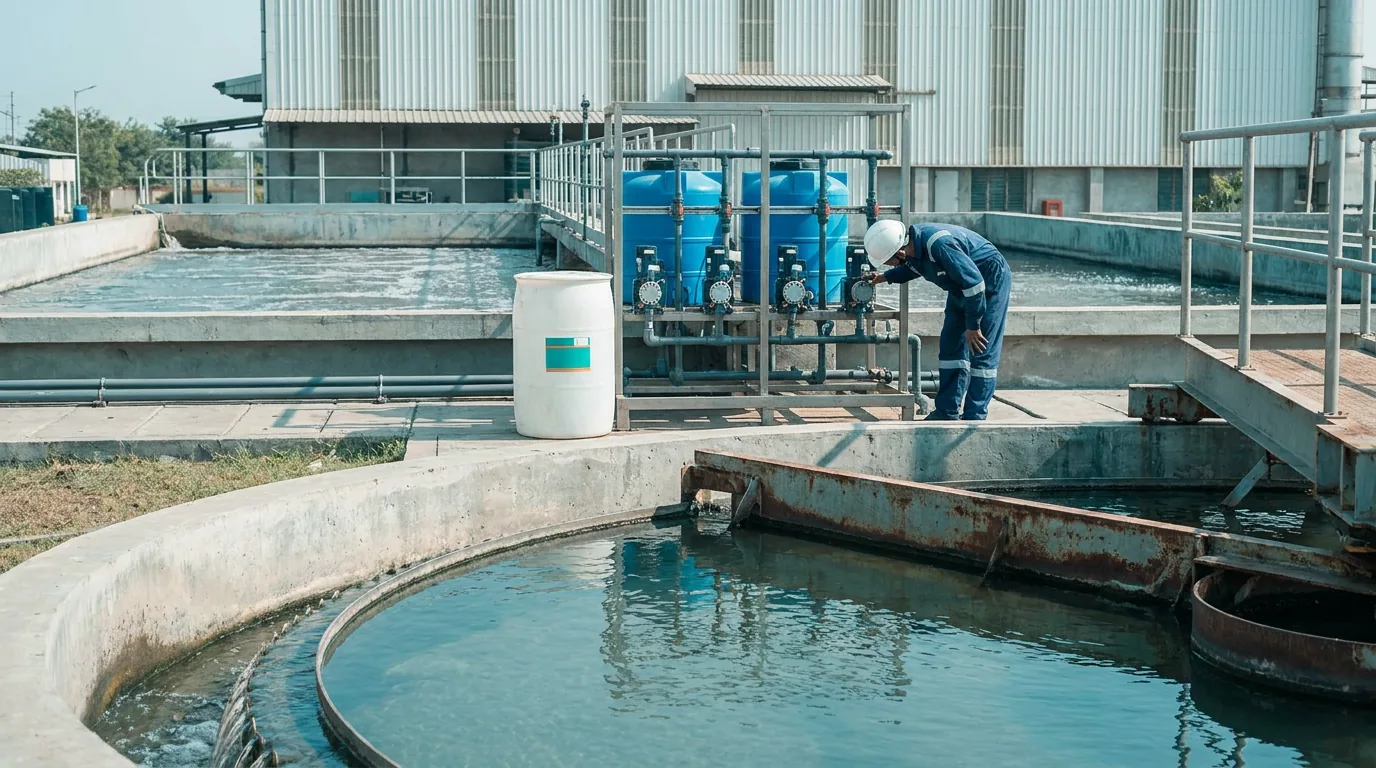
What Goes Wrong in a Poorly Dosed ETP or STP
- Poor clarificationSuspended solids, colour and turbidity carry over from the clarifier when the coagulant type or dose does not match the effluent.
- Weak floc and wet sludgeThe wrong flocculant grade gives small floc that settles slowly and sludge that dewaters poorly, raising disposal volume and cost.
- pH swingsAcidic or alkaline batches upset coagulation and the biological stage, and push outlet pH out of limits.
- Discharge limit riskHigh TSS, COD, colour or phosphate at the outlet puts your discharge consent at risk.
Our coagulant line includes liquid ferric sulphate made by our group company, Kranti Chemicals, at its own facility in Gujarat — the same product it exports. Flocculants and pH correction are selected to work with it on your effluent.

How Our ETP & STP Programme Works
Characterise Your Effluent
We review flow, pH, TSS, COD, colour and phosphate — and how much they vary between batches and shifts.
Jar Test
Coagulant and flocculant combinations and doses are compared on your own effluent, to find the clearest water and best sludge at the lowest cost.
Dose and Commission
We set dosing points, rates and pH targets in writing. Dosing pumps and tanks are available on request.
Monitor and Review
Outlet quality and sludge are tracked; dosing is adjusted as the load changes and reviewed with you monthly.
The Readings That Keep It on Target
Tracked from your first analysis through every monthly review — so problems show up as a trend, not a failure.
- pH (inlet and after correction)Sets the coagulant’s working window and protects the biological stage.
- TSS and turbidityShow how well coagulation and settling are working.
- COD / BODThe main measure of organic load against your discharge limits.
- ColourDyes and organics that coagulation can lift out — important for textile and chemical effluent.
- PhosphateRemoved by iron-based coagulants; often a discharge limit.
- Sludge volume (SV30)Shows floc quality and how much sludge you will handle.
Chemicals Used in This Programme
Grades and doses are confirmed by jar test on your effluent. TDS and MSDS are shared with every product.
Coagulation
Liquid ferric sulphate
Flocculation
Polyelectrolyte flocculant — anionic Polyelectrolyte flocculant — cationic
pH Correction
pH correction chemicals
Liquid ferric sulphate is manufactured by our group company, Kranti Chemicals, which also exports it for water treatment.
ETP & STP Treatment FAQ
Why use ferric sulphate as a coagulant?
Iron-based coagulants work across a wide pH range, form dense floc that settles quickly, and also remove phosphate and some colour. The final choice is made from a jar test on your effluent.
Do you run jar tests before recommending a programme?
Yes. We test coagulant and flocculant options on a sample of your effluent first, so the programme is based on your water rather than a standard dose.
Can the same team treat our boilers and cooling towers?
Yes. Most plants we support run boilers, cooling towers and RO alongside their ETP or STP, and one technical team covers all of them.
Get a Programme for Your ETP or STP
Send an effluent sample or your latest outlet analysis. We’ll jar-test it and recommend coagulant, flocculant and pH dosing.