
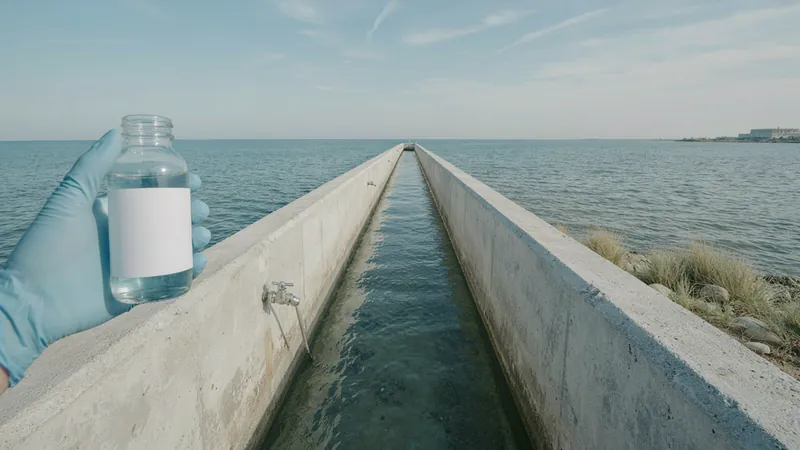
Short answer: SWRO brine is about 1.5–2 times as salty as seawater and also carries the antiscalant dosed upstream, traces of coagulant and, at times, spent cleaning solutions. Choosing an antiscalant that works at a low dose — and a phosphorus-free polymer grade where discharge limits are tight — neutralising CIP waste, and controlling SBS all reduce the impact.
What Is in the Brine
- Concentrated salts: at 35–50% recovery the brine is roughly 1.5–2 times the feed salinity.
- Antiscalant: it does not stay on the membranes — it leaves with the brine, concentrated by the same factor.
- Pretreatment residues: ferric coagulant and polymer in filter backwash, if it is combined with the brine.
- Cleaning waste: acid, alkaline and biocide solutions from CIP, if not treated separately.
- Low oxygen: excess sodium bisulphite can lower dissolved oxygen in the discharge.
Antiscalant Chemistry and Phosphorus
Many antiscalants are based on phosphonates such as HEDP. They are effective and economical, but they add phosphorus to the brine, which can act as a nutrient in the receiving water. Polymer-based, phosphorus-free antiscalants avoid this. Which is right depends on your scaling risk, your dose and your discharge conditions.
The biggest lever is often the dose itself. A grade matched to your seawater analysis can protect the membranes at a lower dose than a generic product — less chemical in, less chemical out. See how to calculate antiscalant consumption.
Good Practice That Reduces the Load
- Match the antiscalant grade to the water and review the dose as seawater changes with the season.
- Collect and neutralise CIP waste before it joins the brine.
- Treat filter backwash separately where possible, so ferric sludge is settled out rather than discharged.
- Control SBS from an ORP reading — see SBS overdosing and biofouling.
- Keep records of chemical use per cubic metre of water produced; it is the simplest sustainability metric to report.
Regulation
In India, coastal desalination plants typically need coastal regulation zone clearance and a discharge consent from the state pollution control board, which set the conditions for the outfall. Check your own consent conditions before changing chemicals.
How Kranti Water Helps
We supply both HEDP-based and polymer-based RO antiscalants, so the choice is made on your water and discharge needs rather than on what we happen to stock. See our desalination plant chemicals page.
Questions
Does antiscalant end up in desalination brine?
Yes. Antiscalant leaves the RO system with the brine, concentrated by the same factor as the salts, so a lower effective dose means less antiscalant in the discharge.
What is a phosphorus-free antiscalant?
A polymer-based antiscalant that controls scale without phosphonates, avoiding phosphorus in the brine discharge.
Running an SWRO or BWRO plant?
Send us your feed-water analysis, recovery and membrane type. We'll recommend antiscalant, cleaning and pretreatment chemicals with dosages within 48 hours.
See Desalination Chemicals