
ISO 9001:2015 Certified · Manufacturer & Exporter
SWRO · BWRO · Pretreatment

Desalination Plant Chemicals

Kranti Water, Vadodara, manufactures and supplies chemicals for seawater (SWRO) and brackish-water (BWRO) desalination plants: RO antiscalants, CIP membrane cleaners, membrane biocide, and ferric sulphate and polyelectrolytes for pretreatment. Every programme starts from your own feed-water analysis, with dosages and target ranges in writing.

  • ~35,000mg/L salts in seawater feed
  • 35–50%typical SWRO recovery
  • 55–70 barSWRO operating pressure
  • 48 hoursto a written programme
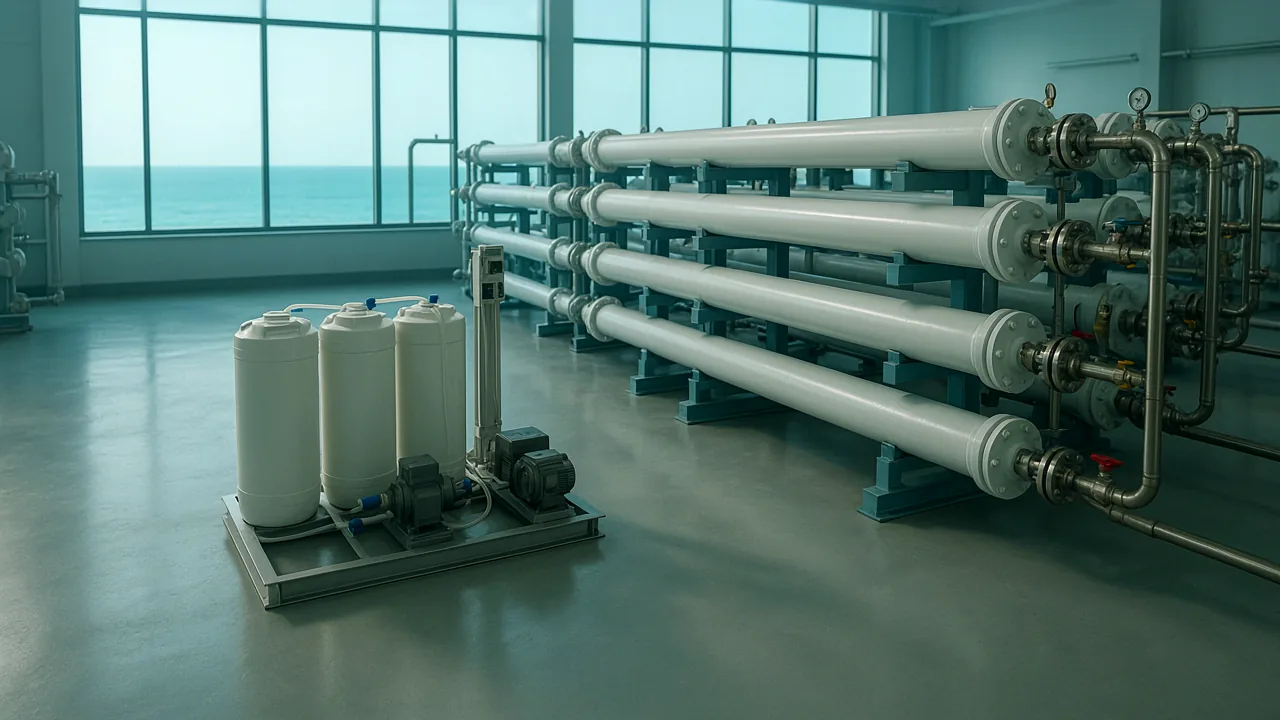
Chemical dosing skid with dosing pumps beside rows of RO pressure vessels in a seawater desalination plant

Seawater Cooling or Desalination?

Two different systems, two different chemical programmes.

Seawater & high-salinity

Cooling and Process Water on Seawater

For plants that use seawater or brine to cool equipment or in the process. The water is not made drinkable — we protect the pipes, towers and exchangers.

  • Seawater cooling towers
  • Once-through condensers
  • Heat exchangers
  • Brine & bittern
See seawater treatment
Desalination plants

Making Fresh Water With RO Membranes

For SWRO and BWRO plants that turn seawater or saline borewell water into fresh water — we protect the membranes and keep the permeate flowing.

  • Seawater RO (SWRO)
  • Brackish-water RO (BWRO)
  • Pretreatment
  • Membrane cleaning (CIP)
✓ You are on this page

Not interchangeable: strong cooling-water biocides such as chlorine destroy RO membranes, and antiscalants are formulated for one duty or the other. Tell us which system you run and we will match the chemistry.

Chemicals by plant stage

Chemicals Used in a Desalination Plant

A desalination plant doses chemicals at every stage, from the seawater intake to the product water. This is what each one does, and which ones we supply. Grades and dosages are confirmed after your feed-water analysis.

Plant stageChemicalWhat it doesFrom Kranti Water
Seawater intakeSodium hypochloriteControls marine growth in intake lines and pretreatmentAsk us
Pretreatment: coagulationFerric sulphateBinds colloids and silt so DAF, media filters or UF remove them, lowering SDILiquid ferric sulphate — made by our group company, Kranti Chemicals
Pretreatment: flocculationPolyelectrolyte (coagulant aid)Builds stronger floc ahead of clarifiers and filtersPolyelectrolytes — anionic and cationic grades
Before the membranesSodium bisulphite (SBS / SMBS)Removes residual chlorine, which damages polyamide RO membranesAsk us
RO feedAntiscalantStops calcium carbonate, calcium sulphate, barium and strontium sulphate and silica scale as the brine concentratesHigh-TDS antiscalant Ca/Mg/metal antiscalant Polymer antiscalant Low-pH antiscalant
RO systemMembrane-compatible biocideControls biofouling on the membrane surfaceMembrane biocide
CIP cleaningAcid, alkaline and organic cleanersRemove scale, metal oxides, organics and biofilm to restore flux and pressure dropAcid cleaner Alkaline cleaner Organic cleaner
Post-treatmentLime + CO₂ or calciteRemineralises permeate so it is stable and not corrosive in the networkAsk us
Plants we treat

Desalination Systems We Treat

Products shown are what we typically select from our range.

Seawater RO (SWRO)

The challenge
Feed water at around 35,000 mg/L of dissolved salts, pushed through membranes at 55–70 bar for 35–50% recovery. Sulphate scale and biofouling raise energy use and shorten membrane life.
Our approach
Antiscalant chosen from your seawater analysis — including barium and strontium — and your recovery and temperature, a CIP schedule set on trend, and membrane-compatible biocide.

High-TDS antiscalant Ca/Mg/metal antiscalant Acid cleaner Alkaline cleaner Organic cleaner Membrane biocide

Brackish-Water RO (BWRO)

The challenge
Saline borewell and creek water on the Gujarat coast carries high hardness, silica and iron, and BWRO plants run at higher recovery — so the concentrate scales quickly.
Our approach
Polymer or calcium/magnesium/metal antiscalant matched to the feed, a low-pH grade where acid is dosed, and acid and alkaline cleaning when normalised data says so.

Polymer antiscalant Ca/Mg/metal antiscalant Low-pH antiscalant Acid cleaner Alkaline cleaner

Pretreatment (DAF, Media Filters, UF)

The challenge
Silt, algae and colloids — worst in the monsoon and during algal blooms — push SDI up and foul the RO membranes downstream.
Our approach
Ferric sulphate coagulation and polyelectrolyte set by jar test on your own seawater, with SDI and turbidity tracked before the cartridge filters.

Liquid ferric sulphate Polyelectrolytes

Brine, Concentrate & Evaporators

The challenge
Concentrated brine in reject lines, evaporators and heat exchangers is the most scaling- and corrosion-prone water in a plant.
Our approach
Scale inhibitor programmes for brine lines and evaporators, and anti-foam formulations where columns foam — trialled in-plant before the programme is fixed.

Tower antiscalant Ca/Mg/metal antiscalant

Not the same chemistry

Desalination vs Seawater Cooling: Different Chemicals

Both run on seawater, but a cooling system protects metal and heat transfer, while a desalination plant protects membranes. Using cooling-water chemistry on RO membranes can damage them permanently.

Seawater coolingDesalination (RO)
PurposeProtect pipes, towers, condensers and heat exchangersProtect RO membranes and keep product water flowing
AntiscalantCooling tower antiscalant for hot water at low cyclesRO antiscalant, including barium and strontium sulphate control
BiocideOxidising and non-oxidising biocides, alternated, plus bio-dispersantMembrane-compatible biocide only — chlorine is removed before the membranes
CleaningOccasional descalingPlanned acid, alkaline and organic membrane cleaning (CIP)
PretreatmentScreens and intake chlorinationFerric coagulant and polyelectrolyte to lower SDI
Corrosion controlEssential — chloride attacks steel and copper alloysHandled mainly by materials (duplex stainless, plastics)
How we work

How We Run a Desalination Programme

  1. Feed-water analysispH, TDS, chloride, calcium, magnesium, sulphate, alkalinity, silica, iron, barium, strontium, boron, SDI and temperature — from the intake and the RO feed.
  2. Scaling check at your recoveryWe check scaling risk for carbonate, sulphate and silica at your recovery and temperature, then set the antiscalant grade and dose in writing.
  3. Pretreatment reviewCoagulant dose, SDI and the chlorine residual reaching the cartridge filters — most membrane fouling starts upstream.
  4. Trial against a baselineYour previous data is recorded first, so the trial result is measured, not guessed. An engineer supports the first dosing on site.
  5. Monitoring & cleaning on trendNormalised permeate flow, pressure drop and salt rejection reviewed monthly; CIP when flow falls or pressure drop rises 10–15%.

Who We Work with on Desalination

  • Municipal desalination plants and their O&M operators
  • EPC contractors commissioning SWRO and BWRO plants
  • Captive desalination at refineries, chemical parks and coastal power plants
  • Bromine, salt and chemical works on brine and saline water
  • Gujarat coast — Kutch, Jamnagar, Saurashtra, Bharuch–Dahej — plus pan-India supply and export
Questions

Desalination Chemicals FAQ

What chemicals does a seawater desalination plant use?

A seawater RO plant typically uses hypochlorite at the intake, a ferric coagulant and polyelectrolyte in pretreatment, sodium bisulphite to remove chlorine, an antiscalant ahead of the membranes, membrane-compatible biocide, acid and alkaline CIP cleaners, and remineralisation chemicals after RO. Kranti Water supplies the antiscalants, CIP cleaners, membrane biocide, ferric sulphate and polyelectrolytes, with doses set from your own feed analysis.

What is the difference between seawater treatment and desalination chemicals?

Seawater treatment chemicals protect cooling towers, condensers and heat exchangers that use seawater or brine: cooling antiscalants, alternating biocides, bio-dispersant and corrosion control. Desalination chemicals protect the RO membranes that turn seawater or brackish water into fresh water: RO antiscalants, membrane cleaners, membrane-compatible biocide and pretreatment coagulants. They are not interchangeable — chlorine-based biocides used in cooling water destroy RO membranes.

Does Kranti Water supply desalination chemicals in Gujarat and across India?

Yes. Kranti Water, the water treatment division of Kranti Chemicals in Vadodara, Gujarat, manufactures and supplies chemicals for SWRO and BWRO desalination plants across India and exports them. Most of our seawater work is on the Gujarat coast.

Which antiscalant is used in SWRO plants?

An antiscalant that holds calcium carbonate, calcium sulphate and barium and strontium sulphate in solution at high TDS. We choose between our high-TDS (HEDP-based), polymer, calcium/magnesium/metal and low-pH grades from your seawater analysis, recovery and temperature.

What dose of SWRO antiscalant is typical?

SWRO antiscalant is usually dosed in the low single-digit ppm range on feed water, but the right dose depends on your seawater analysis, recovery and temperature. We calculate it from your own analysis rather than using a fixed number.

When should SWRO membranes be cleaned?

Typically when normalised permeate flow falls or differential pressure rises by 10–15% from the baseline after start-up or the last clean. Cleaning on trend, rather than on failure, extends membrane life.

Why does pretreatment matter so much in desalination?

Most SWRO fouling starts upstream. Good coagulation and filtration lower SDI and turbidity, which cuts cleaning frequency and protects the membranes. We set the ferric sulphate and polyelectrolyte dose by jar test on your own seawater.

What feed-water analysis should I send for a desalination proposal?

Ideally pH, TDS or conductivity, chloride, calcium, magnesium, sulphate, alkalinity, silica, iron, barium, strontium, boron, SDI and temperature, plus your recovery and membrane type. If you do not have a recent analysis, we can collect a sample and test it.

Can Kranti Water supply EPC contractors and O&M operators?

Yes. We supply on a programme basis, with a technical data sheet and MSDS for every product, dosages and target ranges in writing, and on-site support for start-up dosing.

How quickly can you recommend a desalination chemical programme?

Within 48 hours of receiving your feed-water analysis or sample, with products, dosages and the target ranges we will hold.

Send Us Your Feed-Water Analysis

Share your seawater or brackish feed analysis, recovery and membrane type — or ask us to collect a sample. We'll recommend a programme with target ranges and dosages within 48 hours.