
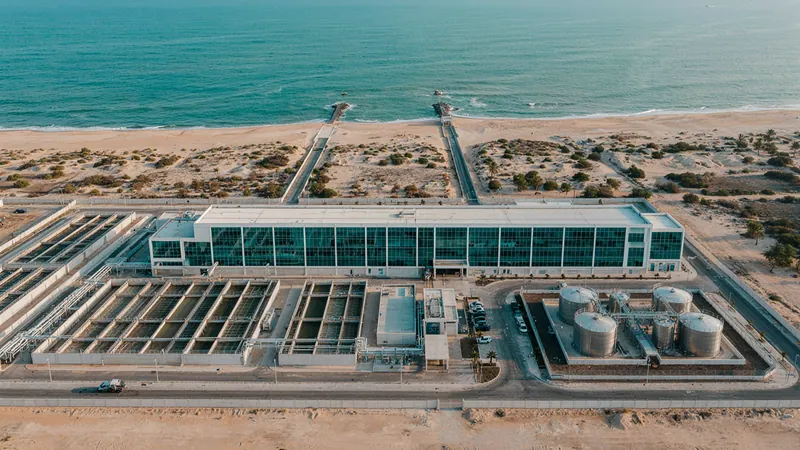
Short answer: a seawater reverse osmosis (SWRO) plant typically doses a chlorine-based biocide at the intake, a ferric coagulant and polyelectrolyte in pretreatment, sodium bisulphite to remove chlorine, an antiscalant ahead of the membranes, a membrane-compatible biocide, acid and alkaline cleaners for clean-in-place (CIP), and lime or calcite with CO₂ after RO to remineralise the product water.
The chemicals are small in volume compared with the water treated, but they decide how long the membranes last and how much energy the plant uses. This guide walks through each stage in the order the water meets it.
1. Seawater Intake: Controlling Marine Growth
Open seawater carries algae, bacteria, larvae and mussel spat. Left alone, they colonise intake pipes, screens and pretreatment tanks within weeks. Most plants dose sodium hypochlorite at the intake, either continuously at a low level or as periodic shock doses.
The chlorine has to be gone before the water reaches the RO membranes, because polyamide membranes are damaged by oxidants. That is why dechlorination (stage 4) always follows.
2. Coagulation: Ferric Sulphate or Ferric Chloride
Seawater contains fine silt, colloids and organic matter that pass straight through a filter. A ferric coagulant — ferric sulphate or ferric chloride — neutralises their charge so they clump into particles that dissolved air flotation (DAF), media filters or ultrafiltration can remove.
The goal is a low and stable silt density index (SDI) at the RO feed. Most membrane manufacturers want SDI₁₅ below 5, and below 3 gives a comfortable margin. The right ferric dose is found by jar test on your own seawater, and it changes with the season — monsoon turbidity and algal blooms both push it up.
3. Flocculation: Polyelectrolyte as Coagulant Aid
A small dose of polyelectrolyte (a long-chain polymer, anionic or cationic) builds the small ferric flocs into larger, tougher ones that settle or float and filter more easily. Overdosing is a real risk: excess polymer carries through and fouls the membranes, so the dose is kept low and checked by jar test.
4. Dechlorination: Sodium Bisulphite (SBS / SMBS)
Sodium bisulphite (SBS), usually made up from sodium metabisulphite (SMBS) powder, reacts with any chlorine left in the water. In theory it takes about 1.46 mg of SBS — or 1.34 mg of SMBS — per mg of chlorine; plants dose a modest excess and control it with an ORP or free-chlorine analyser.
Too little SBS lets chlorine reach the membranes. Too much wastes chemical and, as we explain in SBS overdosing and biofouling, can make biofouling worse.
5. Antiscalant: Before the Membranes
As seawater passes through the membranes, about half of it leaves as fresh water and the salts stay behind in a smaller volume. At 35–50% recovery the brine is roughly 1.5–2 times as concentrated as the feed. Calcium carbonate, calcium sulphate, barium and strontium sulphate and silica can then exceed saturation and form scale on the last membranes.
An antiscalant dosed continuously into the RO feed keeps these salts in solution. SWRO antiscalant is usually dosed in the low single-digit ppm range; the right grade and dose depend on your seawater analysis, recovery and temperature. Our article on barium and strontium sulphate scaling covers the hardest case.
6. Membrane Biocide
Because chlorine cannot be used on the membranes, biofouling inside the RO system is controlled with a membrane-compatible, non-oxidising biocide, dosed periodically. A rise in differential pressure across the first stage is the usual first sign that biofouling is building.
7. Clean-In-Place (CIP) Chemicals
Even a well-run plant needs membrane cleaning. Acid cleaners remove carbonate scale and metal oxides; alkaline and organic cleaners remove biofilm, organics and silt. Plants usually clean when normalised permeate flow falls or differential pressure rises by 10–15% from the baseline — see when to clean SWRO membranes.
8. Post-Treatment: Remineralisation
RO permeate is very low in calcium and alkalinity, which makes it aggressive to pipes and concrete. Plants add lime and CO₂, or pass the water through calcite, to restore hardness and alkalinity so the water is stable in the distribution network. A second RO pass with caustic pH adjustment is sometimes used where boron limits are tight.
Summary Table
| Stage | Chemical | Purpose |
|---|---|---|
| Intake | Sodium hypochlorite | Stops marine growth |
| Coagulation | Ferric sulphate / chloride | Removes colloids, lowers SDI |
| Flocculation | Polyelectrolyte | Builds stronger floc |
| Dechlorination | SBS / SMBS | Protects membranes from chlorine |
| RO feed | Antiscalant | Prevents scale in the brine |
| RO system | Membrane biocide | Controls biofouling |
| CIP | Acid, alkaline, organic cleaners | Restores flux and pressure drop |
| Post-treatment | Lime + CO₂ or calcite | Remineralises product water |
Where Kranti Water Fits
Kranti Water, Vadodara, supplies RO antiscalants, CIP cleaners, membrane biocide, and ferric sulphate and polyelectrolytes for pretreatment, with doses set from your own feed-water analysis. See our desalination plant chemicals page, or estimate your monthly consumption with the antiscalant and SBS consumption calculator.
Questions
What chemicals are used in a seawater desalination plant?
Typically sodium hypochlorite at the intake, a ferric coagulant and polyelectrolyte in pretreatment, sodium bisulphite to remove chlorine, an antiscalant before the membranes, a membrane-compatible biocide, acid and alkaline CIP cleaners, and lime or calcite with CO₂ for remineralisation.
Why is chlorine removed before RO membranes?
Polyamide RO membranes are damaged by chlorine and other oxidants, so any chlorine added at the intake is neutralised with sodium bisulphite before the water reaches the membranes.
Running an SWRO or BWRO plant?
Send us your feed-water analysis, recovery and membrane type. We'll recommend antiscalant, cleaning and pretreatment chemicals with dosages within 48 hours.
See Desalination Chemicals