
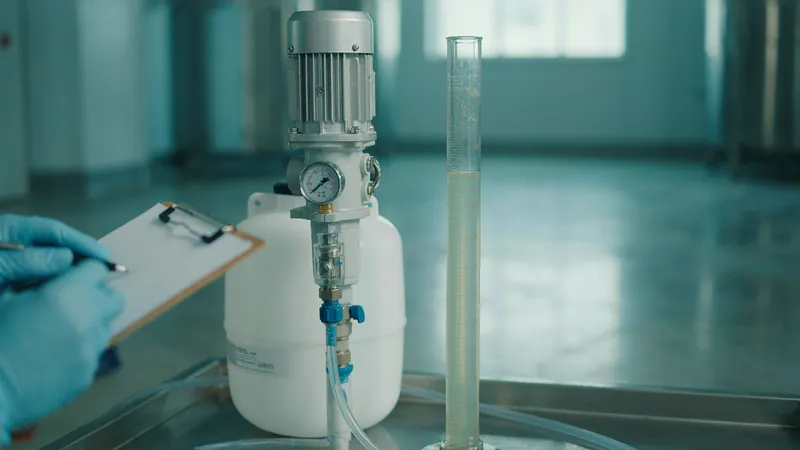
Short answer: antiscalant consumption in kg per day equals the dose in mg/L (ppm) × the RO feed flow in m³/hr × 24 ÷ 1000. Multiply by 30 for a month, divide by your drum size for the number of drums, and divide the hourly figure by the product's specific gravity to get the dosing pump setting in litres per hour.
The Formula
One ppm is one gram per cubic metre of water. So for a product dosed as supplied:
- kg/hour = dose (ppm) × feed flow (m³/hr) ÷ 1000
- kg/day = kg/hour × 24
- kg/month = kg/day × 30
- Pump setting (L/hr) = kg/hour ÷ specific gravity of the product
Two details trip people up. First, the dose is applied to the feed flow, not the permeate flow — the antiscalant has to treat all the water entering the membranes. Second, check whether the recommended dose is "as supplied" or "as active"; if it is as active, divide by the product's active fraction.
Worked Example
An SWRO train takes 1,000 m³/hr of feed. At 45% recovery that produces about 10.8 million litres of fresh water a day. The antiscalant is dosed at 2.5 ppm as supplied, the product's specific gravity is 1.2, and it comes in 50 kg drums.
| Step | Calculation | Result |
|---|---|---|
| kg per hour | 2.5 × 1,000 ÷ 1,000 | 2.5 kg/hr |
| kg per day | 2.5 × 24 | 60 kg/day |
| kg per month | 60 × 30 | 1,800 kg/month |
| Drums per month | 1,800 ÷ 50 | 36 drums |
| Pump setting | 2.5 ÷ 1.2 | about 2.1 L/hr |
The numbers in this example are illustrative. Your own dose comes from your seawater analysis, recovery and temperature.
Diluting in a Day Tank
Many plants dilute the antiscalant in a day tank so the pump runs at a comfortable stroke. If you dilute 1 part product with 4 parts RO permeate, the pump has to deliver five times the neat flow — in the example, about 10.4 L/hr of solution. Always dilute with permeate rather than raw water, and make up the tank fresh as the supplier recommends.
Why Doses Differ Between Plants
- Recovery: higher recovery concentrates the brine more and needs more protection.
- Temperature: warm seawater raises carbonate scaling risk; cold water lowers sulphate solubility.
- Feed chemistry: barium, strontium, silica and iron all change which grade works best.
- Antiscalant grade: a product matched to your water can work at a lower dose than a generic one.
SWRO antiscalant is usually dosed in the low single-digit ppm range. If your plant needs much more than that, the grade may not be right for your water.
Use the Calculator
Our free antiscalant and SBS consumption calculator does these sums for you, including the sodium bisulphite needed to remove a given chlorine residual. For a grade and dose matched to your plant, send us your feed-water analysis — see desalination plant chemicals.
Questions
How do you calculate antiscalant consumption?
Multiply the dose in ppm by the RO feed flow in m³/hr and divide by 1000 to get kg per hour; multiply by 24 for kg per day and by 30 for a month.
Is antiscalant dose based on feed or permeate flow?
On feed flow. The antiscalant has to treat all the water entering the membranes, including the part that leaves as brine.
Running an SWRO or BWRO plant?
Send us your feed-water analysis, recovery and membrane type. We'll recommend antiscalant, cleaning and pretreatment chemicals with dosages within 48 hours.
See Desalination Chemicals